AI Operating System for a Multi-Brand Hospitality Group
A case study on AI-first ERP, predictive analytics, CRM, POS intelligence, inventory controls, and omnichannel guest workflows across hospitality brands.
The challenge
A growing hospitality group was operating multiple restaurant and venue formats with different teams, menus, customer segments, inventory behavior, and service rhythms. Demand patterns were shifting by daypart, outlet, campaign, weather, events, and neighborhood behavior.
The group had digital systems in place, but decision-making still depended heavily on manual follow-ups, spreadsheets, memory, and isolated reports. Leaders wanted a more intelligent operating layer without forcing every outlet into a rigid process.
The business had several operational questions that could not be answered cleanly from existing systems. Which outlet needed more staff this week? Which campaign produced repeat customers rather than one-time spikes? Where was alcohol movement deviating from expected consumption? Which guest segments were responding to loyalty activity? Which menu or inventory decisions were being made too late?
Hospitality operations also move quickly. A system that requires central teams to manually reconcile data after the fact does not help outlet managers during service. The group needed intelligence that could sit closer to daily operations: reservations, POS, CRM, inventory, campaign response, guest feedback, and management review.
What Aiera took over
Aiera started by taking ownership of the operational map: sales flow, reservations, guest feedback, stock movement, alcohol tracking, POS behavior, campaign response, and management reporting.
The goal was not to replace hospitality judgment. It was to give owners, outlet managers, and central teams better daily signals and reduce repetitive coordination.
The first step was to separate what needed to be standardized from what needed to stay flexible. Master data, outlet comparisons, guest records, inventory definitions, and management metrics needed discipline. Service style, outlet context, manager judgment, and brand-specific operating behavior needed room.
Aiera worked through each major workflow and identified the decisions that mattered: what should be predicted, what should be routed, what should be reviewed, what should be alerted, and what should be left to human discretion. That became the foundation for the AI-first ERP, CRM, and analytics layer.
The solution
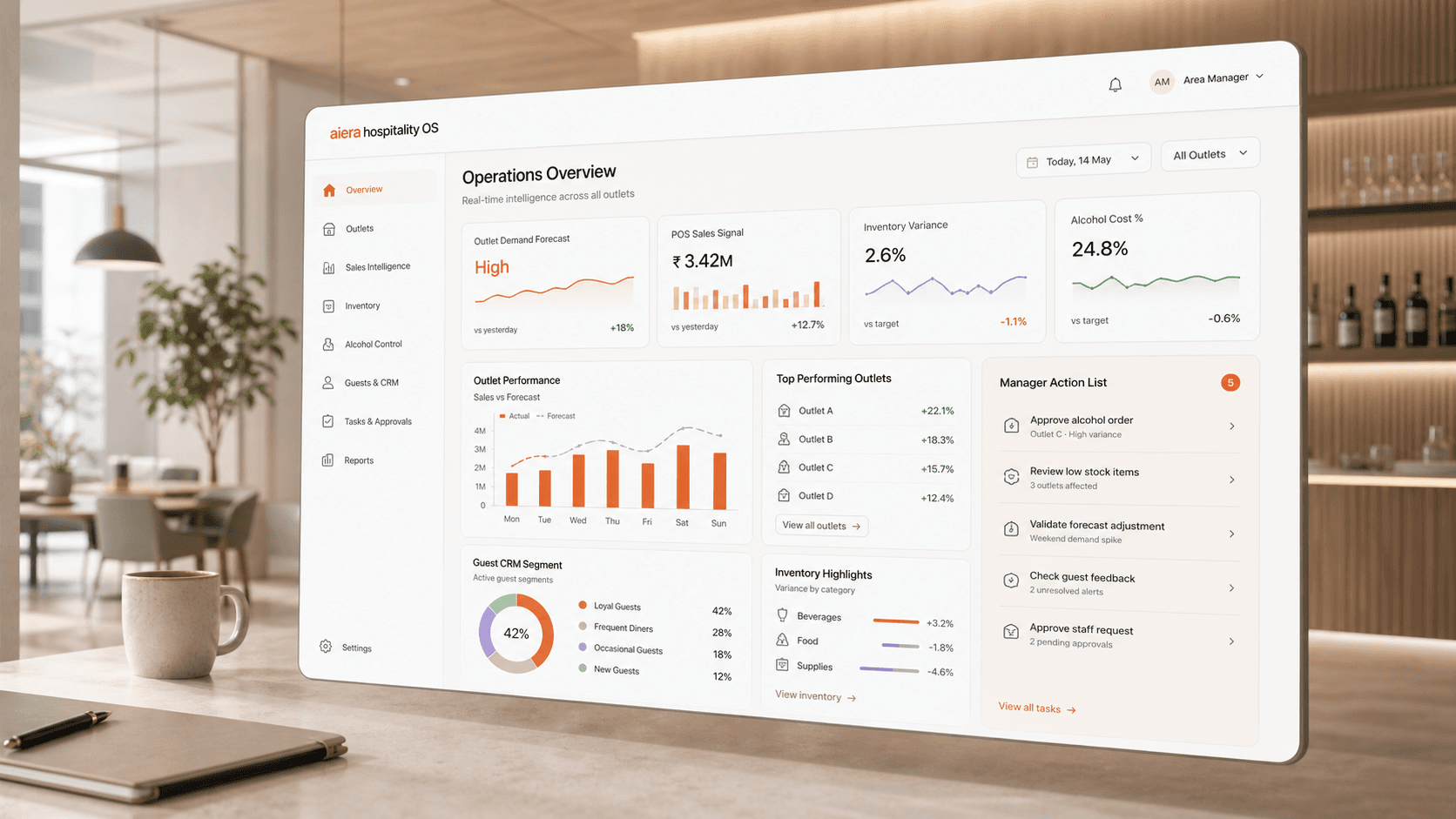
Aiera designed an AI-first ERP and CRM layer connected to POS and operational data. Predictive analytics highlighted outlet-level demand signals, likely stock pressure, campaign performance, customer cohorts, and exceptions that needed intervention.
Custom workflows supported guest engagement, escalation, reservations, loyalty actions, and operational approvals. For alcohol-led venues, tracking workflows gave teams more control over movement, variance, and accountability.
The system brought together three types of intelligence. The first was operational intelligence: outlet performance, stock pressure, guest demand, and service exceptions. The second was customer intelligence: visit history, campaign response, preference signals, loyalty activity, and follow-up opportunities. The third was management intelligence: dashboards and reviews that helped leaders compare brands, outlets, and time periods without waiting for manual reporting.
Instead of building a generic dashboard, Aiera designed views around hospitality decisions. An owner needed a portfolio view. An outlet manager needed an action list. A central team needed exception queues. A marketing team needed campaign and guest-cohort visibility. Finance and inventory teams needed tighter controls around movement, variance, and reconciliation.
How it was implemented
The engagement was sequenced by operational value. Aiera first stabilized master data and reporting logic, then built predictive and workflow modules around the most expensive bottlenecks.
Outlet teams received lightweight interfaces for daily use, while central leadership received dashboards for comparison, forecasting, and control. Adoption was handled through operating reviews, not one-time software training.
The rollout began with the workflows where inconsistency was creating the most friction: outlet reporting, inventory visibility, guest follow-up, and demand signals. Once those foundations were usable, the system expanded into predictive planning, CRM workflows, loyalty triggers, and alcohol tracking.
The implementation avoided a big-bang ERP replacement. Existing systems remained in place where they worked. Aiera connected the data and workflows around them, then introduced AI where it could improve decisions or reduce coordination. This helped teams adopt the system without pausing operations.
Training was designed around the weekly and daily rhythm of hospitality management. Teams reviewed dashboards in operating meetings, used exception queues during follow-up, and adjusted workflows based on real usage. This made adoption practical rather than theoretical.
The outcome
The group moved from fragmented reporting to a more connected operating cadence. Outlet leaders gained clearer signals for staffing, stock, guest engagement, and campaign follow-up, while central teams gained a sharper view of performance across brands.
The biggest shift was managerial. Leaders no longer had to rely only on delayed reports or informal updates to understand what was happening. Outlet teams had better daily visibility. Central teams had a more reliable way to compare performance and intervene. Campaigns, guest engagement, inventory, and operational controls became part of the same intelligence layer.
The work also created a more scalable technology foundation. As the group adds outlets, formats, or campaigns, the system can extend through workflows and data models rather than starting again from spreadsheets and manual reporting.