Omnichannel AI Contact Center for Higher Education Admissions
How a university group used AI to manage student enquiries, admissions follow-ups, lead qualification, and counselor handoffs across channels.
The challenge
A higher education institution was receiving a large volume of student and parent enquiries across calls, web forms, WhatsApp, campaign sources, and walk-in follow-ups. Counselors were spending too much time on repetitive questions and too little time on qualified, high-intent conversations.
The institution needed a system that could respond quickly, qualify intent, maintain context, and route the right student to the right counselor without making the admissions journey feel automated or impersonal.
Admissions teams were also dealing with uneven follow-up discipline. Some students received fast responses. Others were delayed because their enquiry came through a different channel or because the counselor did not have full context. Campaign teams could see lead volume, but not always lead quality. Leadership could see final admissions numbers, but not enough about where prospects were getting stuck.
The institution needed to protect the human part of admissions. Students and parents still needed counselor guidance for fitment, fees, programme choices, eligibility, and final decisions. The AI system had to make the journey more responsive without turning admissions into a generic support queue.
What Aiera took over
Aiera mapped the admissions funnel from first enquiry to application, counseling, document collection, follow-up, and conversion. Each journey was broken into intents, data fields, qualification signals, and escalation rules.
The design principle was simple: AI handles repeatable information and structured follow-up; counselors handle persuasion, fitment, financial discussion, and final decision support.
The mapping exercise included source attribution, programme interest, eligibility questions, geography, preferred channel, urgency, parent involvement, document readiness, and next-step status. This helped Aiera define what the system needed to know before a counselor became involved.
Aiera also reviewed the knowledge base that powered admissions conversations. Programme information, intake details, campus information, eligibility criteria, document requirements, scholarship or fee guidance, and common parent questions had to be governed centrally. Without that discipline, automation would only reproduce inconsistent answers faster.
The solution
Aiera built an omnichannel AI contact center that could respond to common programme questions, capture student context, qualify leads, trigger reminders, and route conversations with full history.
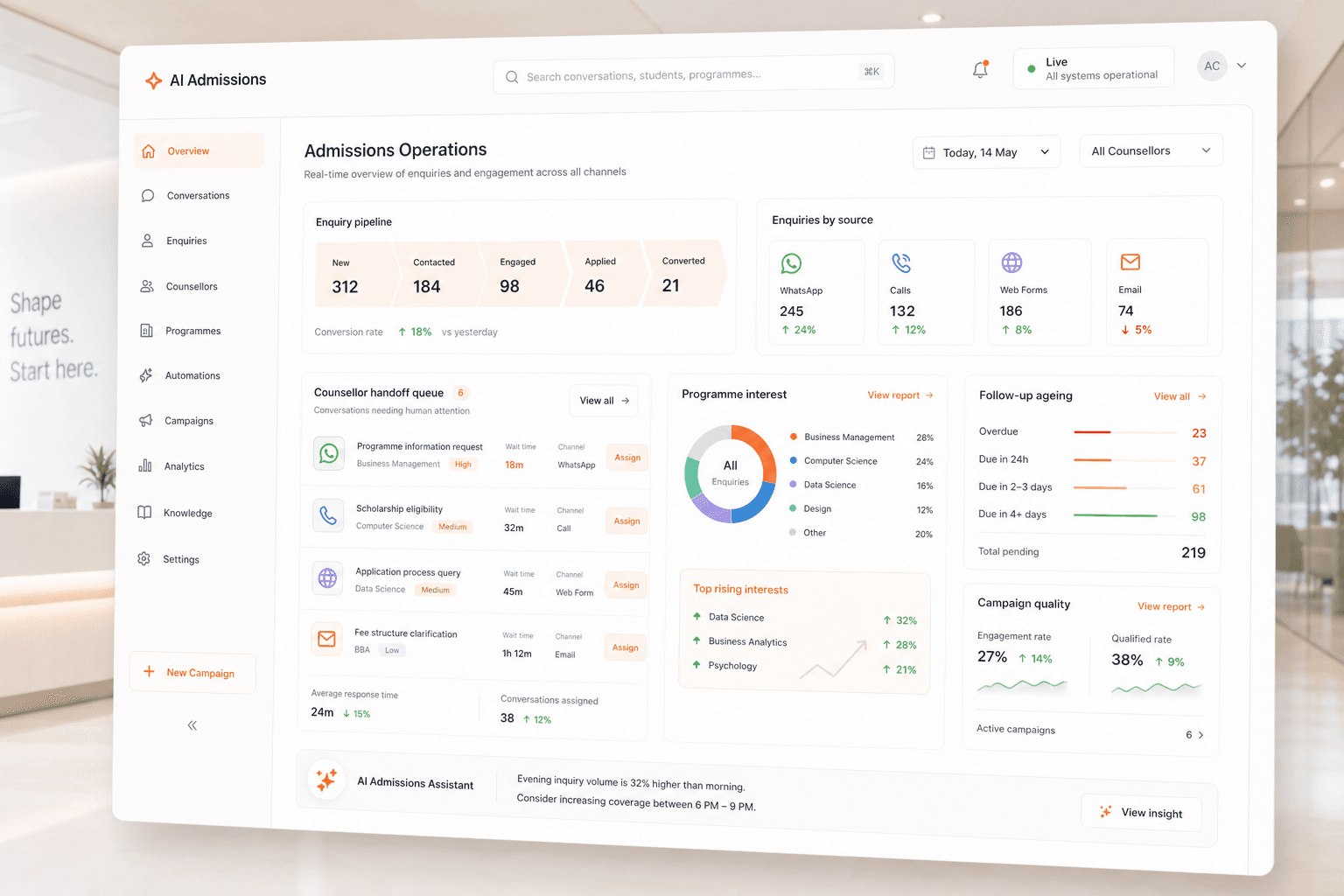
Dashboards gave admissions leaders visibility into enquiry sources, counselor load, follow-up ageing, unresolved conversations, and campaign quality.
The contact center unified the first layer of interaction across channels. Students could ask programme questions, share basic information, request callbacks, and receive structured follow-up. Parents could get answers to common process questions. Counselors received qualified records rather than disconnected messages.
The routing model was built around counselor effectiveness. High-intent students, complex questions, and sensitive financial or fitment discussions moved to human teams with context. Lower-intent or incomplete enquiries stayed in structured nurturing workflows until they were ready for counselor time.
Dashboards were designed for admissions operations rather than generic call-center reporting. Leaders could review source quality, response ageing, counselor workload, unanswered intents, and stage movement. This helped teams understand not just how many leads were coming in, but which ones were moving.
How it was implemented
The first release focused on high-frequency admissions questions and lead capture. Subsequent releases added counselor workflows, routing logic, source-level reporting, and structured handoff notes.
Knowledge content was governed centrally so answers stayed consistent across channels. The system was tuned around admissions operations rather than generic support automation.
The rollout began with a limited set of programmes and common enquiry types. This allowed the team to validate tone, qualification logic, and handoff quality before expanding. Aiera worked with admissions users to refine the data capture fields, qualification questions, and counselor notes.
Once the basic journey was stable, campaign-source reporting and follow-up rules were added. This gave marketing and admissions teams a shared view of lead quality. Follow-up reminders and ageing dashboards helped reduce silent drop-offs between enquiry and counseling.
Adoption depended on counselor trust. The system was designed so counselors could see what the AI captured, where the lead came from, what the student asked, and what still needed to be resolved. That made the AI layer feel like preparation rather than interference.
The outcome
The institution gained a more responsive admissions layer and a clearer operating view of its enquiry pipeline. Counselors spent more time on serious prospects, while leadership gained better visibility into demand, follow-up discipline, and channel performance.
Students and parents experienced faster first responses and more consistent information. Counselors received better-prepared conversations. Admissions leaders gained a clearer picture of channel quality, counselor capacity, and unresolved demand.
The larger operating change was a shift from channel-by-channel follow-up to a unified admissions workflow. The institution could treat admissions as a managed journey: capture, qualify, route, counsel, follow up, and review.